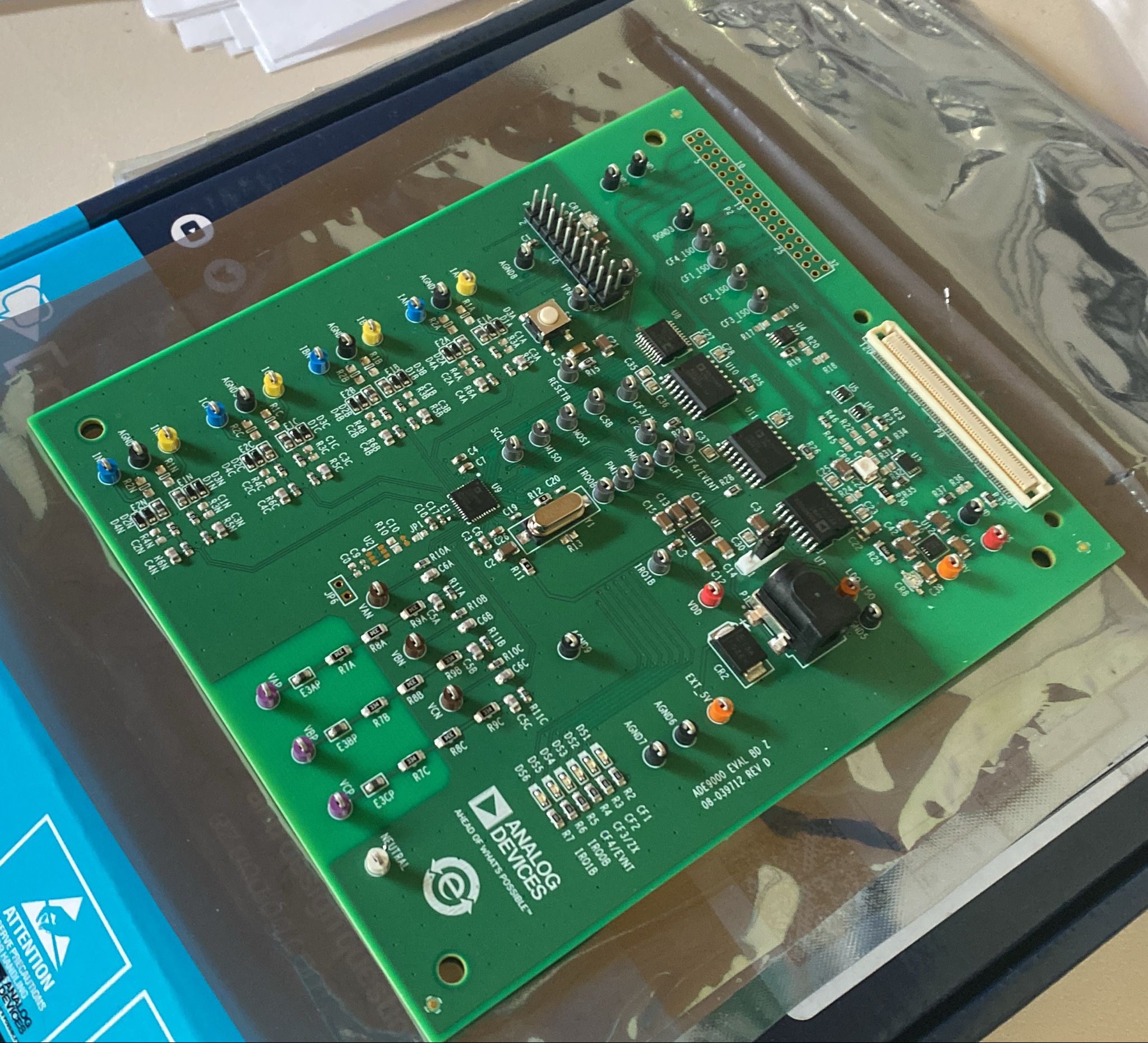
High-Precision Polyphase Energy Measurement System Using ADE9000
Designed and developed a Class 0.5S / 0.2S-grade three-phase energy metering system built around the Analog Devices ADE9000 multiphase energy and power quality metering AFE, interfaced with an embedded microcontroller over SPI for real-time acquisition of active, reactive, and apparent energy.
Overview
Developed a three-phase precision energy measurement system using the Analog Devices ADE9000 metering AFE. Designed the analog front-end (CT/shunt current sensing, voltage scaling, anti-aliasing) and embedded firmware over SPI for register configuration, multi-point calibration, and real-time readout of active/reactive/apparent energy, RMS, power factor, frequency, and THD. Achieved metering-class accuracy suitable for AMI deployment.
Challenge
The ADE9000 (Key Specs)
•   High-accuracy multiphase metering IC with seven 24-bit Σ-Δ ADCs
•   Measures active, reactive, and apparent energy/power per phase plus total
•   Better than ±0.1% energy accuracy over a wide dynamic range
•   Onboard RMS (1/2-cycle and 10/12-cycle), power factor, frequency, and total harmonic distortion (THD) computation
•   Power quality features: dip/swell detection, angle measurement, zero-crossing, peak detection
•   Waveform buffer (sample capture) for harmonic and waveform analysis
•   SPI interface, programmable interrupts, and energy-pulse outputs (CF1–CF4)
Technical Contributions (frame these as your work)
•   Hardware front-end design: current sensing via shunt/CT, voltage divider networks, anti-aliasing filters, and the ADE9000 SPI bus to the MCU
•   Firmware development for register configuration, calibration (gain/phase/offset), and energy accumulation readout
•   Implemented gain, phase, and offset calibration routines to meet target accuracy class
•   Real-time data pipeline streaming RMS, power, energy, PF, and frequency to a host/display
•   Integrated communication protocols (e.g., Modbus RTU/RS485 or MQTT) for data reporting
Approach
-
Requirements & Accuracy Target
Defined the metering accuracy class (e.g., Class 0.5S for active energy, Class 2 for reactive) and the measurement range for voltage, current, and frequency based on the target application (AMI / industrial metering). -
Analog Front-End Design
• Current sensing using current transformers (CTs) or shunt resistors with appropriate burden/scaling
• Voltage sensing via resistor divider networks scaled to the ADE9000 input range (±0.707 V differential)
• Anti-aliasing RC filters on each channel to match the IC’s Σ-Δ sampling
• Proper grounding, isolation, and PCB layout to minimize noise coupling -
Hardware Interface
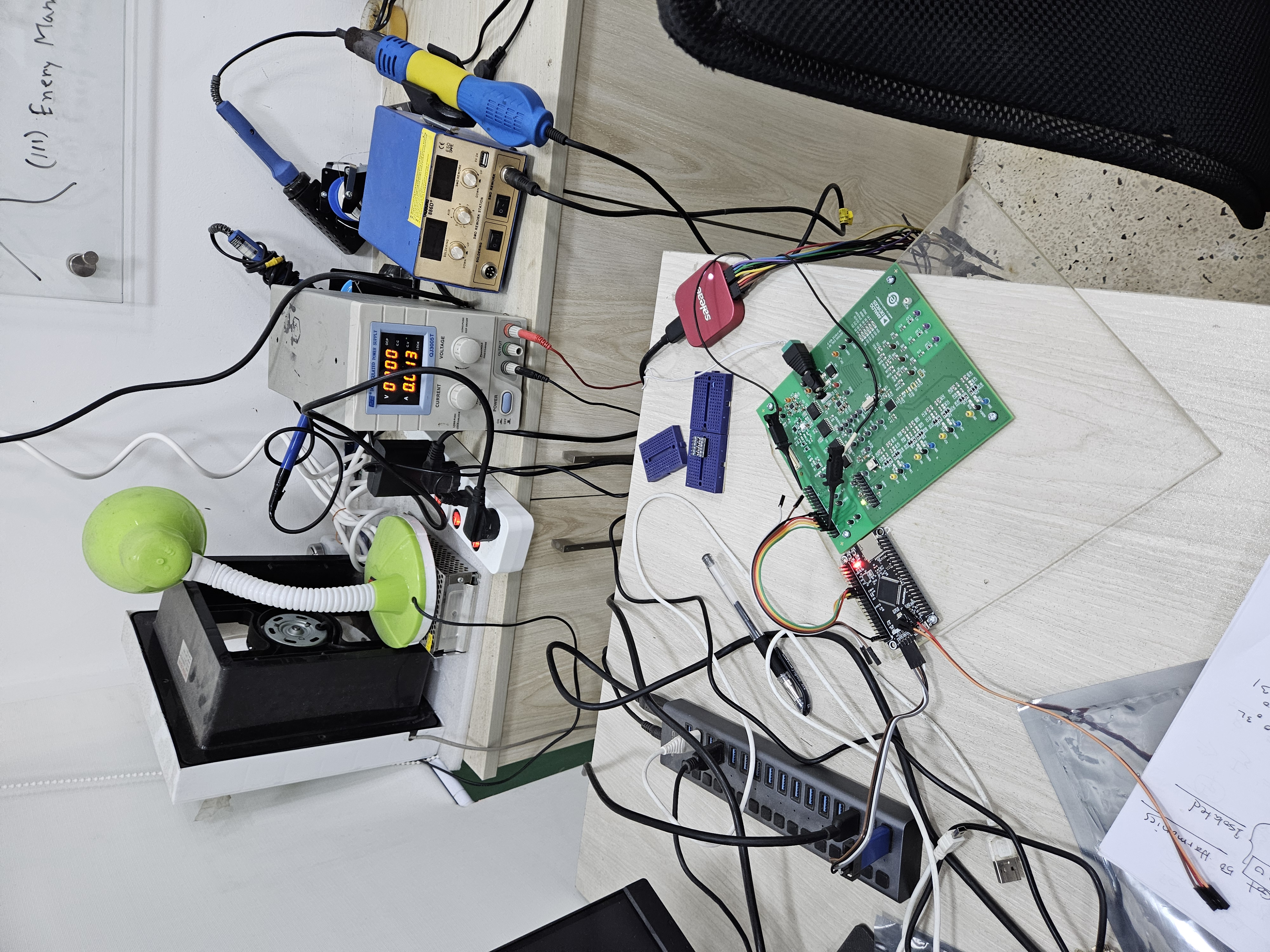
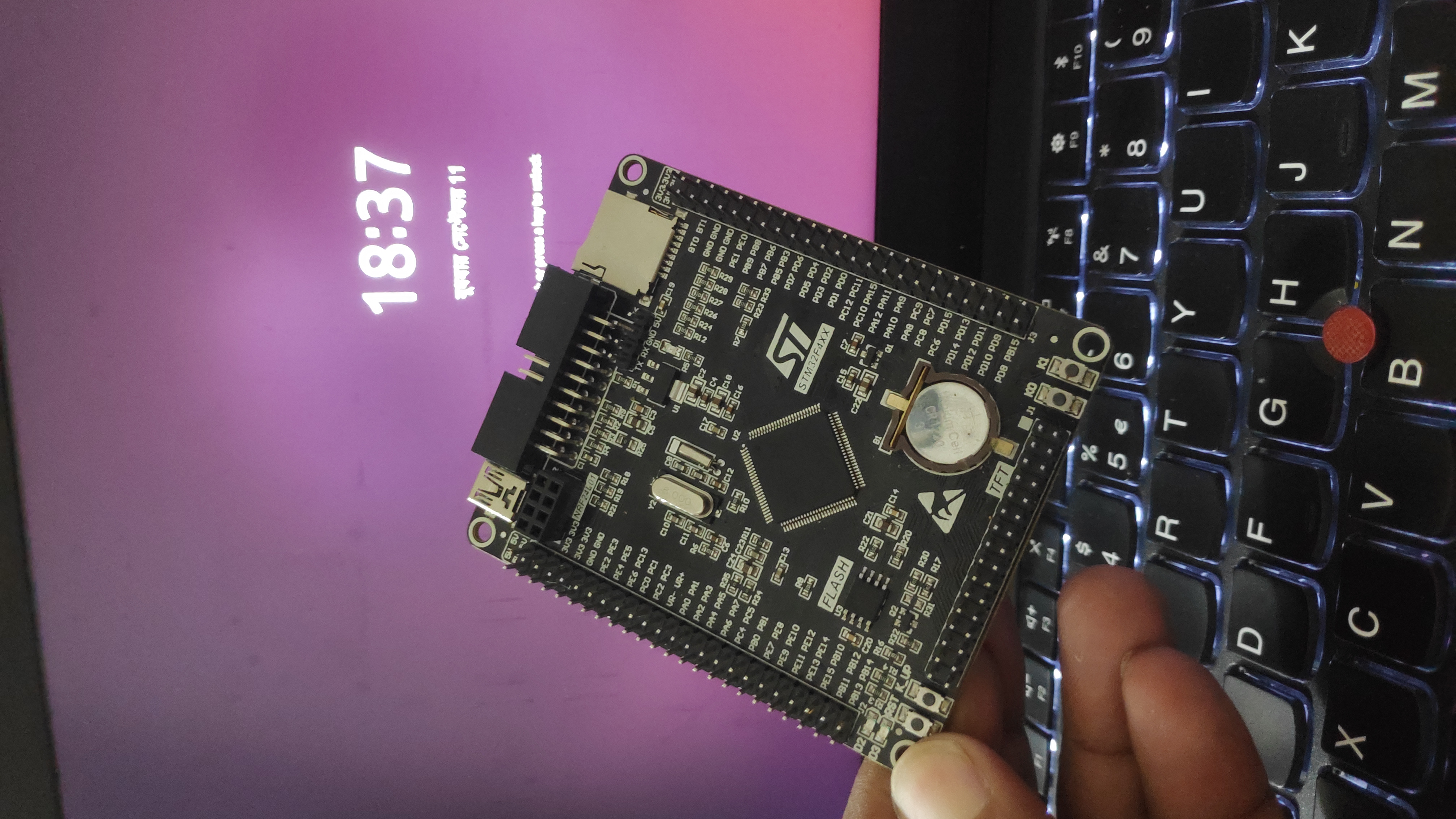
Connected the ADE9000 to the host MCU over SPI (configuring as the metering AFE), routing the CF energy-pulse outputs and IRQ lines for event-driven readout. -
Firmware Development
• Register initialization sequence (configuration, gain, threshold registers)
• Energy accumulation readout (line-cycle or sample-based)
• Continuous acquisition of RMS, active/reactive/apparent power, power factor, and frequency
• Interrupt handling for zero-crossing, dip/swell, and energy-pulse events -
Calibration
Performed multi-point calibration against a reference source/meter:• Gain calibration for voltage and current channels
• Phase (delay) calibration to correct CT phase error
• Offset calibration to null residual readings at no-load -
Validation
Verified output against a reference standard meter across the dynamic range, varying load and power factor to confirm linearity and accuracy.
Results
• Achieved energy measurement accuracy within the target metering class (typically better than ±0.5% active energy error across the rated range after calibration)
• Accurate per-phase and total measurement of active, reactive, and apparent energy
• Reliable real-time reporting of RMS, power factor, and frequency with stable readings
• Successful phase-error correction, bringing measurement error within tolerance at low power factor
• Stable, repeatable performance suitable for AMI / industrial deployment
• Validated data pipeline delivering metering data to the host for logging and communication
Gallery
36 views